Top 10 Benefits Of Hydroponics And Its Impact On Agriculture

The hydroponic farming system is winning hearts globally. The way the plant is grown and the high amount of produce is obtained can solve all the issues farmers face in conventional land farming. The benefits of choosing Hydroponics over other farming techniques have put many farmers on the path to never-ending prosperity. It has constantly been improving the trajectory of the agricultural sector. Also, Hydroponics is one of the best ways to ensure food security for the increasing Indian population.
Hydroponics Farming - An Overview
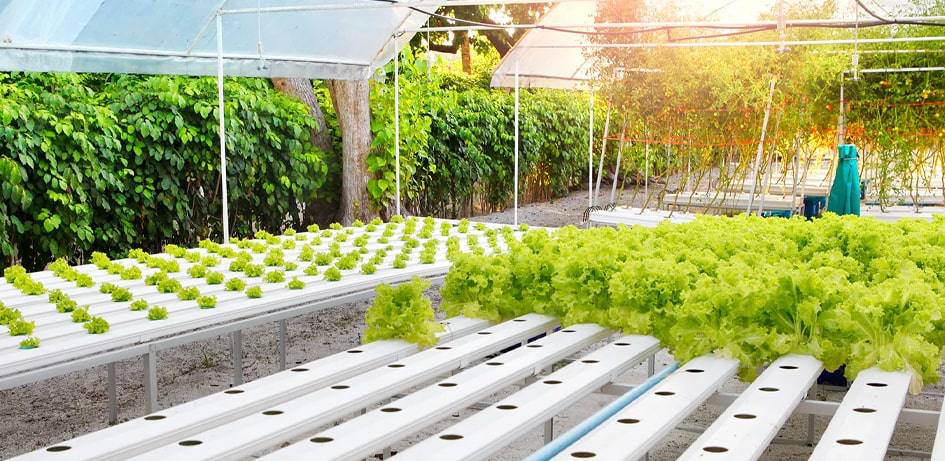
Hydroponics farming is the soil-less technique of growing crops. The required nutrients by crops to grow are provided by nutrient-enriched water solution. It is the method of growing crops in a controlled environment. The closed space keeps the growing crops from all kinds of harmful effects. The quality and quantity of the product are far better than what is generally obtained from conventional farming practices.
The farming practices deployed in the hydroponic farm do not contribute to the rising methane concentration in the environment that causes global warming. It benefits the environment in many ways like it does not waste lots of water as is in the case of conventional farming, and also soil does not lose its nutrient content. There are many advantages to choosing Hydroponics over others, and the top 10 among them are mentioned below.
Top 10 Benefits Of The Hydroponic Farming:
Optimal Water Usage
Water is used only as much as required and not more than that in a hydroponic farming technique. The water loss due to evaporation is also negligible. In comparison to the open field farming, it uses 90% less water. Hence, Hydroponics uses water resources quite optimally.
In conventional farming, the farm water contains huge concentrations of various harmful chemicals. The water runoff from the farm fields contaminates the nearby water body, which is quite poisonous to the aquatic beings. There are no such harmful effects of the water disposed of by hydroponic farms.
Optimal Space Utilisation
As the nutrients required for crop growth are provided on the roots, the crops don’t need to spread their roots. Due to this effect, they require lesser space to grow than they do in land farming. A producer can grow many crops in a lesser space. Also, there is an option to grow crops vertically and produce even more crops in a particular space. Hydroponics allows farmers to make the best use of available space.
Faster Rate Of Growth
The required nutrients are provided directly to the roots, and crops do not need to absorb them from the soil; this saves a lot of time, and crops mature early. The crops that are grown in the hydroponic farm setup grow 60?ster than in the open fields and hence a higher growth rate.
Higher Productivity
The productivity of the hydroponic farm is way more than land farming. A farmer can grow crops faster and can grow crops anytime without waiting for the off-season to pass. Hence, at the year-end, producers would have multiple crops than what they could have generated from land farming.
Minimal Crop Damage
Due to the closed environment of the corp growth, there are no chances of crop damage due to external factors. The robust and reliable hydroponic structure saves crops from the harmful effects of heat waves, cold waves, strong winds, pest attacks, etc. The crop grows healthy and except for the internal problem called system clogging problem. Clogging hinders the water flow which is avaoidable by regularly flushing the tubes with warm water. So, if you take some precautionary measures, the chances of crop damage are minimal.
No Pesticide Added
As there are no chances of pest attacks in a closed and controlled environment, there is no requirement for the addition of any pesticide for the protection of crops. It saves money for the producer. The crops grow quite healthy and do not harm the consumer.
High-Quality Produce
The crops grown in hydroponic farms are provided with an ample amount of the required nutrients for seamless and healthier growth. The crops are not contaminated by the addition of excess fertilizers and pesticides and hence are healthier when consumed. The quality of the crops is visible outside also, and hence they attract buyers very quickly.
Higher Predictability
The producers are no longer dependent on the unpredictable nature, and as the factors contributing to crop growth are under the producer’s growth, there is an increase in the predictability of the farm production. This certainty boosts the farmers’ confidence.
Higher Revenue Generation
Using Hydroponics, a producer grows a lot of crops, and their quality is second to none. With increased production of high-quality products, the producer generates multiple revenues than the farmer farming on land.
No Unemployment
Most of the 55% of the Indian workforce engaged in agriculture becomes unemployed during the off-season. Hydroponics never allows any farmer to be unemployed, so that food producers never run out of money to put food on their table.
Impact Of Hydroponics On Agriculture
The various benefits of Hydroponics have amazed intellectuals and farmers alike. All the state governments and the Central government have extended a helping hand in the form of subsidies to share the burden of investment done in Hydroponics. Many well-educated and elite people, especially youth, are turning towards the primary sector’s hydroponics business due to the future growth prospects. Hydroponics, with the assured high productivity of high-quality crops, will revolutionize farming practices in a very short time.
The depressing agrarian distress caused by crop failure and lesser productivity can be easily dealt with by adopting Hydroponics. The agriculturists are becoming aware of the fact that Hydroponics may become the driving force of the growth trajectory of the primary sector in a very short time. The smart producers have already boarded the bus of secured life, and the rest of the aware populace has lined up for it.
Some Last Words
Hydroponics has changed the way people used to look at agricultural activities. Farming is no more an unpredictable and unreliable business, and producers don’t compel their children to take to secondary and tertiary sectors employment after education. The advantages of using aquaponics save the nature and future of the producer due to higher yield. Nature and humans can finally live in harmony together. There are huge advantages associated with the hydroponics technique, but the producer needs to deploy quality structure and be well educated and trained to operate the devices. Agriplast - A diligent Engineering Agricultural firm is dedicated to providing the farmers with the best quality structure and imparting required education and training along with any other support needed. We believe in serving the you the best solutions to make a remarkable change in their growth prospects.
Recent Posts
Your Farm. Your Future.
Every great harvest starts with the right conversation. Let our experts design a polyhouse built around your land, crop, and climate.
Talk to an ExpertFrequently Asked Questions
In this video, Abhishek Bhatt, Director of Agriplast Protected Cultivation, will provide a comprehensive breakdown of why Agriplast Polyhouse outperforms other polyhouses in terms of yield. He'll elucidate on key features like superior design, Israeli technology application, and optimal environmental control. The design facilitates enhanced ventilation, ensuring ideal growing conditions. Additionally, the use of Israeli technology, tailored for Indian agricultural needs, plays a crucial role in maximizing yields. Stay tuned to gain valuable insights into how Agriplast Polyhouse revolutionizes protected cultivation for superior agricultural outcomes.
A greenhouse is a transparent structure which is made using glass where plants are grown under certain climatic conditions. The agricultural industry has got many innovations, and the greenhouse technology makes use of modern and smart technology to give optimum facilities to the plants for their better and more efficient growth all around the year. Polyhouse is a kind of greenhouse where polyethene plastic material is used to create the polyhouse instead of the use of glass.
A greenhouse is designed to grow plants even in adverse climatic conditions. The translucent glass that covers the greenhouse gives the plants enough light to let them carry the photosynthesis process easily by absorbing light energy. Since the greenhouse is in an airtight condition, a sufficient amount of sunlight makes the greenhouse warmer from within than the outer atmosphere.
Greenhouse not only warms the greenhouse from within only in summers but in winters; it allows for an artificial heating solution which is effective but is a bit expensive. Some other inexpensive ways of warming up your greenhouse are:
- If you cover the inside of a greenhouse structure with a bubble layer wrap, you will observe a reduction in heat loss.
- Good power supply availability will allow you to add electric fan heaters to circulate hot air within the greenhouse for the plant's growth.
- You can also get electric greenhouse heaters installed that come with an inbuilt thermostat and works automatically when the temperature of the outer surroundings goes down.
Greenhouse benefits you in several different ways, which are listed below:
- Helps in producing fresh crops at any time of the year.
- The facility of producing the crops all around the year, even in adverse climatic conditions.
- The greenhouse allows the farmers to create an exclusive environment for the better plant growth.
- Protects crops from adverse climatic conditions.
- The light energy within a greenhouse is distributed evenly to all the plants.
- Greenhouse installation makes it easy for the farmers to grow crops with less use of pesticides.
- Greenhouse setup helps in saving the total usage of resources.