Capsicum Farming in Polyhouse - Setup, Cost, Yield & Profit Guide
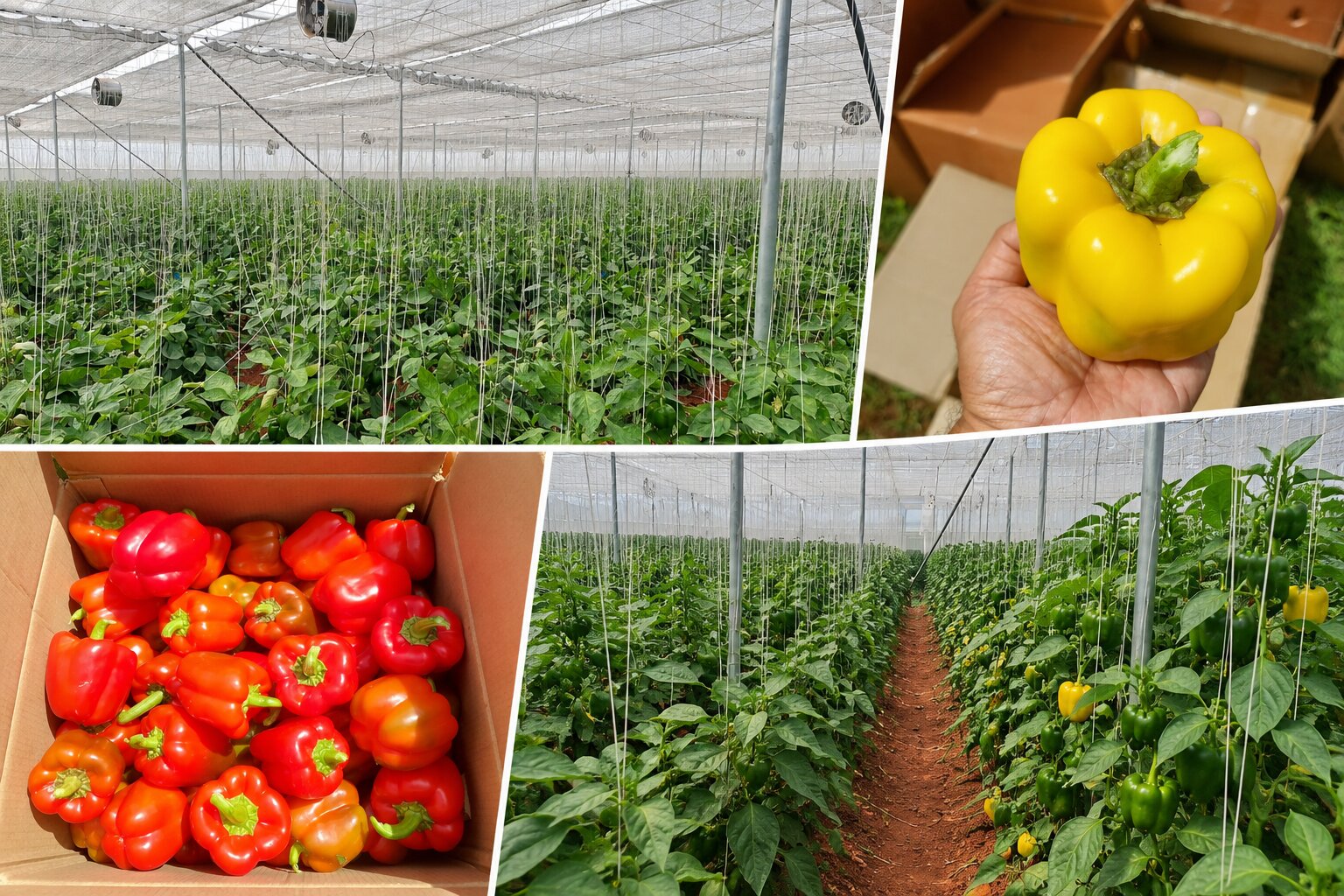
Capsicum farming in polyhouse fixes the three biggest problems of open-field growing: unpredictable weather, pest damage, and poor fruit quality. Farmers control temperature, humidity, and light inside a polyhouse which is a type of greenhouse structure. This control produces uniform, blocky fruit weighing 150 grams or more, with bright, even color. That quality sells at premium prices to supermarket chains, HORECA buyers, and quick-service restaurants. This guide covers the full process of running a commercial polyhouse farm, from site selection to marketing.
Why Does Capsicum Require Protected Cultivation?
A polyhouse gives capsicum controlled temperature, humidity, light intensity, and airflow, letting the plant photosynthesize and respire closer to its full genetic potential. Open fields cap yield because two factors work against the plant: heat and humidity. High temperatures cause flower drop and high humidity triggers fungal outbreaks.
| Attribute | Open-Field Farming | Naturally Ventilated Polyhouse |
|---|---|---|
| Fruit Quality | Variable size, frequent sunscald, irregular color | Uniform blocky shape, intense color, smooth finish |
| Shelf Life | Short (3 to 5 days) | Extended (10 to 15 days under cool storage) |
| Market Value | Low commodity pricing with high volatility | Premium pricing through retail chains and exports |
| Water Efficiency | Low (heavy evaporation and flood losses) | High (drip-fertigation saves up to 80% water) |
| Yield Potential | 10 to 15 tons per acre | 30 to 35 tons per acre |
Polyhouse-grown fruit typically weighs 100 to 120+ grams and has 3 to 4 distinct lobes with a thick pericarp and firm skin. This quality lets farmers sell directly to modern retailers instead of the low-margin wholesale market.
How Much Can a Farmer Earn from Capsicum Polyhouse Farming, and What Is the Payback Period?
A well-managed 1 acre unit of capsicum farming in polyhouses earns ₹26 to ₹28 Lakhs per crop cycle, with farmers typically recovering their full investment in 2.5 to 3.5 years. This comes from a yield of 30 to 35 tons per cycle, sold at prices between ₹40/kg and ₹120/kg (₹75/kg average). The payback timeline shifts with market prices and the farmer's operational skill.
What is the setup cost for a Capsicum Polyhouse?
Setting up a 1 acre Capsicum polyhouse costs roughly ₹45-50 lakhs, depending on your structure and region. This is a one-time cost called CAPEX. It covers four main things: the GI structure frame, polyfilm cover sheets, drip irrigation pipes, and a fertigation mixing unit. Prices shift based on frame height, film quality, and local labor rates.
What are operating expenses for Capsicum Polyhouse Farming?
Running the polyhouse costs around ₹11 lakhs per acre. This recurring spending is called OPEX. It includes seeds, growing media (coco peat for hydroponics or soil amendments for traditional beds), water-soluble fertilizers, pest sprays, insect nets, trellising twine, and labor. Fertilizers and labor usually eat up the biggest share of this budget.
What Subsidies and Loans Are Available for Capsicum Polyhouse Farming?
MIDH and NHB, two central government schemes, refund 35% of polyhouse construction costs. Commercial and rural banks also offer term loans backed by NABARD refinancing. The exact subsidy percentage depends on the state and grower category.
What Documents Are Required for a Polyhouse Loan or Subsidy?
Required documents typically include:
- Land title or a registered long-term lease agreement
- A Detailed Project Report (DPR) with cash-flow projections
- Soil and irrigation water test reports
- Vendor quotes for the polyhouse structure and irrigation system
Subsidy rules change by state and financial year. Verify current terms with your local District Horticulture Office before construction begins. For more details on Subsidy. Click here
What Should You Look for When Selecting Land for a Capsicum Polyhouse?
Selecting the ideal land for a capsicum polyhouse requires careful attention to location, resources, and soil conditions. Choose land with a gentle slope for natural drainage, full sun exposure, year-round clean water access, and proximity to paved roads leading to urban markets. Additionally, ensure the area is free from strong, damaging winds and stays clear of high industrial pollution that can harm polyhouse covers. Finally, test the soil and water beforehand to confirm low salinity levels and a healthy pH range suitable for capsicum growth.
Which Type of Polyhouse Structure Is Best for Capsicum Cultivation?
For most plains regions in India, a naturally ventilated polyhouse works best: 4 to 5 meter gutter height, a 1.2 to 1.3 meter top vent, and 80% side ventilation. This balances cost against climate control. In hot, dry regions, farmers add fan-and-pad systems or high-pressure fogging to bring down temperature further. Some growers start with a lower-cost shade net structure for nursery and hardening stages before investing in a full polyhouse.
What Are the Ideal Climate Conditions for Growing Capsicum in a Polyhouse?
Capsicum needs a controlled range to maximize fruit set and quality:
- Daytime Temperature: 22 to 28 degree
- Nighttime Temperature: 15 to 20 degree
- Relative Humidity: 55% to 70%
- Soil/Media pH: 5.8 to 6.8
- Electrical Conductivity (EC): 1.5–2.5 dS/m (mS/cm) in the vegetative stage, rising to 2.0–3.0 dS/m in flowering/fruiting
How Do You Prepare Land and Soil Before Planting Capsicum in a Polyhouse?
Land prep starts with deep tilling and clearing plant debris, followed by soil and water lab testing before any bed is built. Test results decide the entire fertigation program for the crop's life, so this step comes first.
Water EC should stay below 1.5 dS/m and pH between 6.0 and 7.5 for safe fertigation. Salinity above 2 dS/m requires an RO system. Bicarbonate levels above 200 ppm require acid treatment.
Sterilize the soil through solarization or chemical fumigation to kill pathogens and nematodes. Some growers skip soil entirely and use soilless media like coco peat for more precise root nutrition control.
How Do You Prepare Raised Beds and Drip Irrigation for Capsicum?
Build raised beds 90 cm wide at the top, 100 cm wide at the base, and 40 cm high. Leave a 50 cm walking aisle between beds. Install two drip lines per bed using pressure-compensated emitters (1.3–2.0 LPH). Cover beds with a 25 to 30 micron silver-on-black UV-stabilized mulch film to conserve moisture, block weeds, and reflect light onto the plants.
Which Regions in India Grow Capsicum in Polyhouses?
India's main hubs for capsicum farming in polyhouses are Maharashtra (Pune, Nashik), Karnataka (Kolar, Bengaluru Rural, Chikkaballapur), Himachal Pradesh, Uttarakhand, Punjab, Haryana, and Tamil Nadu (Nilgiris, Hosur).
How Do Hill and Plains Region Farming Strategies Differ for Capsicum?
Hill regions use cool summers to grow off-season, high-price crops with minimal added cooling. Plains regions need active cooling and target an autumn-to-spring window to avoid summer heat. Consequently, growers in warmer plains rely on heavy shade nets, foggers, and humidity management tools to maintain ideal microclimates during peak temperature months.
Which Capsicum Varieties Are Popular for Polyhouses, and When Should You Plant Them?
Preferred hybrids for bell pepper farming: Inspiration and Bachata for red, Orobelle and Pasarella for yellow. Because capsicum is perishable, planting time must be timed against region, calendar, and distance to metro markets together, not planned in isolation.
How Do You Grow a Capsicum Crop in a Polyhouse, Step by Step?
Once the site and structure are ready, growing capsicum in a polyhouse follows five stages: nursery, transplanting, irrigation, training, and harvesting.
How Do You Raise Healthy Capsicum Seedlings in a Nursery?
Healthy seedlings come from certified hybrid seeds started in 98-hole pro-trays and raised inside a 40-mesh insect-proof net house. Fill the trays with sterilized coir pith enriched with Trichoderma harzianum and Pseudomonas fluorescens and this combination supports healthy root development from the start. The net house or polyhouse which is essentially a small shade net enclosure blocks thrips and whiteflies. Seedlings are ready to transplant in 30 to 35 days, at 4 to 5 true leaves.
When Should You Transplant Capsicum Seedlings?
Transplant during cool early morning or evening hours to reduce shock. Transplant during cool early morning or evening hours to reduce shock on the young plants. Ensure seedlings are roughly 30 to 35 days old and have developed 4 to 5 true leaves before moving them to the main beds. Check that the roots are well-formed in the pro-trays and water the beds immediately after planting to help the roots establish smoothly.
What Spacing, Pattern, and Density Should You Use When Transplanting Capsicum?
Plant two rows per bed in a zigzag pattern, spaced 45 cm × 45 cm, giving a density of 3.5 to 4 plants per sq m. Drench beds with a rooting stimulant and fungicide immediately after planting to keep transplants healthy through the shock period.
How Should Capsicum Fertigation Change Across Growth Stages?
Fertigation follows three growth stages, each matched to a distinct phase of capsicum growth from root establishment to fruit coloring.
- Days 1 to 30 (vegetative): High nitrogen/phosphorus mixes (19:19:19, 12:61:0) build roots and canopy.
- Days 31 to 60 (flowering/fruit set): Balanced N:K with Calcium Nitrate and Boron prevents Blossom End Rot.
- Day 61 onward (fruit development): High-potassium mixes (Potassium Nitrate 13:0:45, Potassium Sulfate 0:0:50) build fruit size, wall thickness, and color.
How Do You Set Up Fertigation Stock Tanks A and B for Capsicum?
Split fertigation into two stock tanks to prevent precipitation: Tank A (Calcium, Potassium Nitrate, Iron EDTA) and Tank B (Phosphorus, Magnesium Sulfate, micronutrients).
How Do You Prune and Train Capsicum Plants in a Polyhouse?
At 25 to 30 days, retain 2 main stems (or 3 to 4, by strategy) and prune side shoots. Tie stems to UV-stabilized twine on overhead wires. Remove early crown flowers to build canopy strength first. Continue removing lower older leaves regularly as the plant grows to improve airflow and direct energy to developing fruit.
How Is Pollination Managed Inside a Closed Polyhouse?
Running circulation fans or tapping trellis wires daily between 10 AM and 12 PM helps to aid pollination. Polyhouses have no natural wind, so this manual disturbance is essential. Keep humidity between 50% and 70% during this midday window and it keeps pollen loose enough to drop effectively.
How Do You Maintain the Polyfilm and Structure of a Capsicum Polyhouse?
Wash the external polyfilm every 3 to 6 months to maintain light transmission. Inspect the 200-micron UV-stabilized film regularly for tears and repair with UV-stabilized tape. Additionally, check all structural GI pipes and tension wires before every new crop cycle to prevent sagging or wind damage.
How Does Rainwater Harvesting Work in a Capsicum Polyhouse?
Connect roof gutters (1.6 to 2.0 mm, ≥275 GSM zinc coating) to an underground storage pond or recharge pit. At an average monsoon rainfall of 600 mm, a 1,000 sq m polyhouse roof can collect roughly 600,000 liters of clean, low-EC water since 1 mm of rainfall over 1 sq m yields 1 liter of runoff. This harvested water cuts water treatment and RO operating costs through the dry season.
Does a Polyhouse Fully Eliminate Pest Pressure on Capsicum?
No, a polyhouse doesn't fully eliminate pest pressure rather it only blocks large pests like caterpillars and birds. Smaller pests such as thrips, red spider mites, aphids, and whiteflies still enter through doors, vents, or clothing. Thrips and whiteflies also spread plant disease as they feed. Once inside, all four multiply fast in the warm, humid environment.
What Preventive Measures Help Control Pests in a Capsicum Polyhouse?
Controls: double-door entry airlocks, yellow sticky traps for whiteflies and aphids, blue sticky traps for thrips, dedicated farm aprons for staff, and regular tool sanitation.
Which Diseases Commonly Affect Capsicum in a Polyhouse?
Capsicum crops grown inside polyhouses are frequently affected by powdery mildew, which creates white powdery patches on leaves. Soil-borne fungal diseases such as damping-off and bacterial wilt cause sudden seedling losses and plant collapse. High humidity inside polyhouses also leads to anthracnose or fruit rot, creating dark sunken spots on the produce. Additionally, viral infections such as Tobacco Mosaic Virus and Leaf Curl Virus spread rapidly when pests like thrips and whiteflies enter the structure.
How Do You Prevent and Manage Diseases in a Capsicum Polyhouse?
Prevention starts with sterilizing soil or using clean soilless media alongside disease-resistant hybrid seeds. Farmers install insect-proof nets and double-door airlocks to block vector pests like whiteflies from entering. Proper spacing, pruned branches, and managed ventilation lower internal humidity to prevent fungal spores from spreading. Crop health is maintained through scheduled applications of bio-agents like Trichoderma or targeted bio-fungicides at the first sign of infection.
What Are the Key Risks in Capsicum Polyhouse Farming, and How Do You Manage Them?
Capsicum polyhouse farming faces four main risk categories that are structural, agronomic, utility, and market and each is manageable with specific preventive steps.
| Risk Type | Cause | Mitigation |
|---|---|---|
| Structural | Polyfilm tears, curtain failure, wind damage | Insurance, on-site repair supplies |
| Agronomic | Faulty pH/EC meters, skipped micronutrients, pest outbreaks | Calibrated meters, full nutrient program, early pest monitoring |
| Utility | Power cuts causing water stress | Backup generators or solar storage |
| Market | Over-reliance on local wholesale prices | Buyer agreements signed before planting |
When and How Should You Harvest Capsicum from a Polyhouse?
Harvesting starts 80 to 90 days after transplanting. Pick fruit at 70–80% color, since full color develops during transit. Cut with clean shears, leaving a 2–3 cm pedicel, during cool morning hours.
What Are the Grading Standards for Polyhouse Capsicum?
Polyhouse capsicum is sorted into two grades based on weight, lobe count, and skin quality. Grade A (Premium) covers fruit 150g and above: blocky shape, 3-4 clean lobes, firm skin, no blemishes. Grade B covers fruit 100g to 149g, with clean skin and minor shape variation allowed. Pre-cool harvested fruit to 8-10°C in a shaded packing area to remove field heat before sorting, then pack into ventilated corrugated boxes or padded plastic crates for transit.
What Are the Key Yield Drivers for Capsicum in a Polyhouse?
Three factors drive final yield: pruning, fertigation, and climate control. Disciplined pruning to 2 main stems keeps plant energy focused on fruit development. Balanced fertigation avoids salt build-up in the root zone. Tight control of temperature, humidity, and pollination minimizes flower drop, protecting the fruit set the plant has already produced.
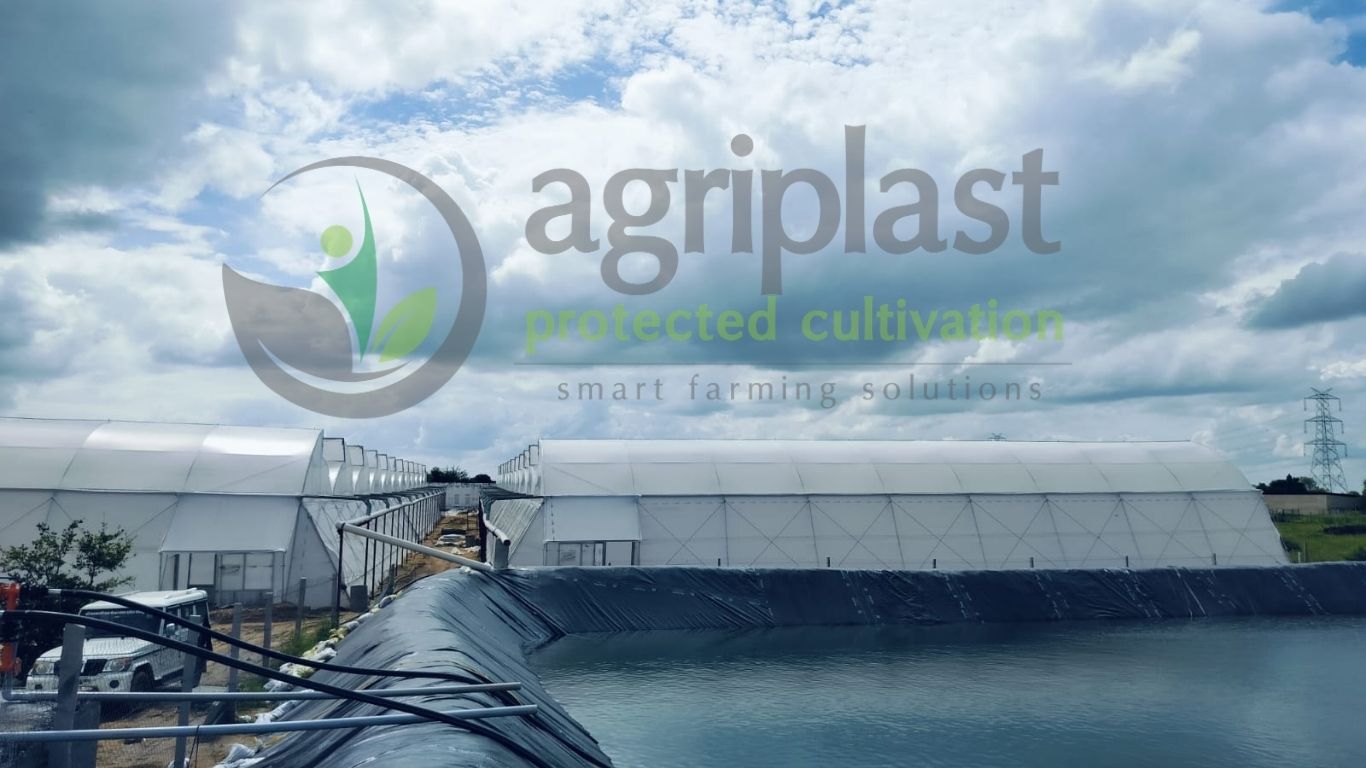
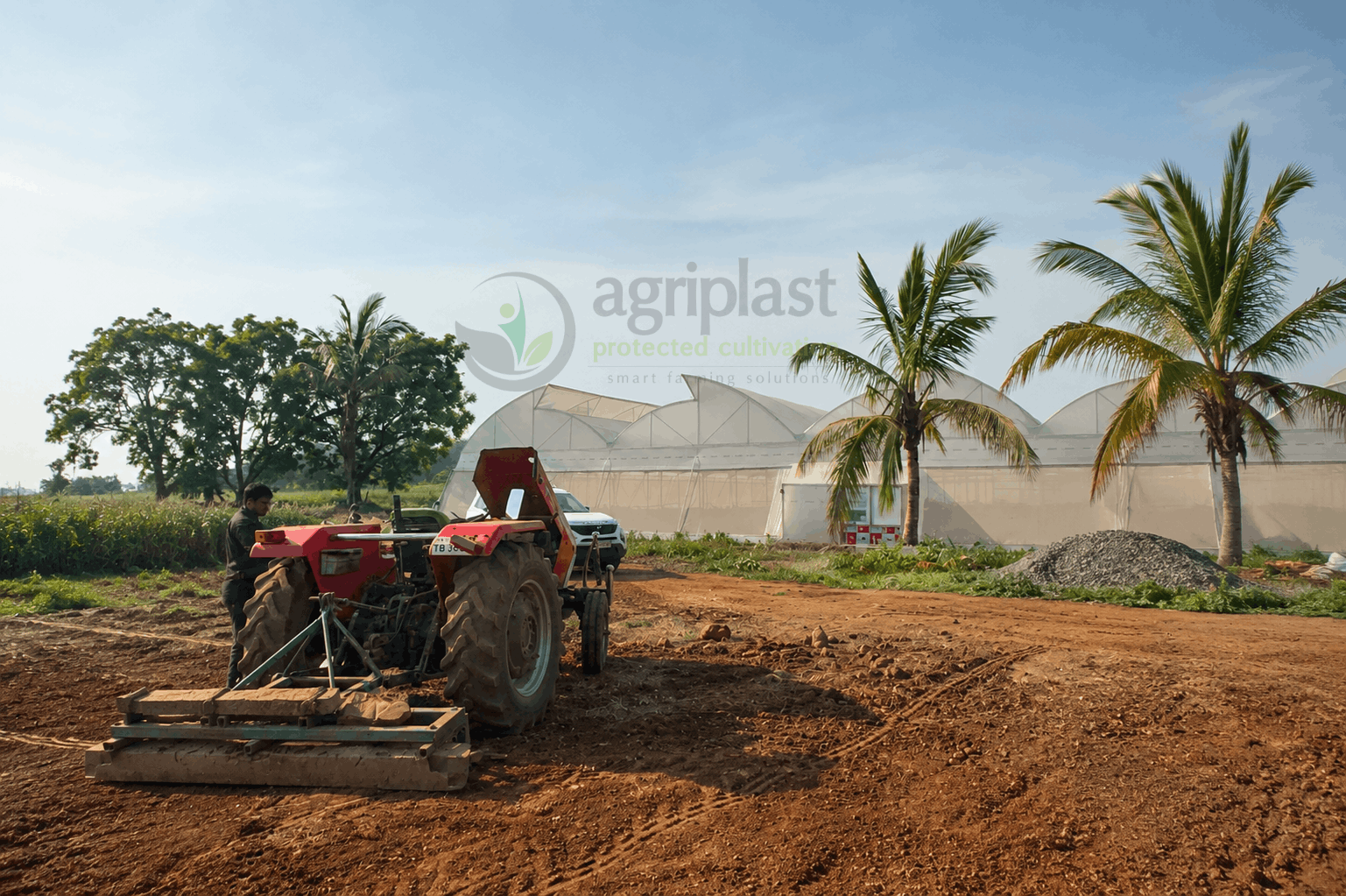
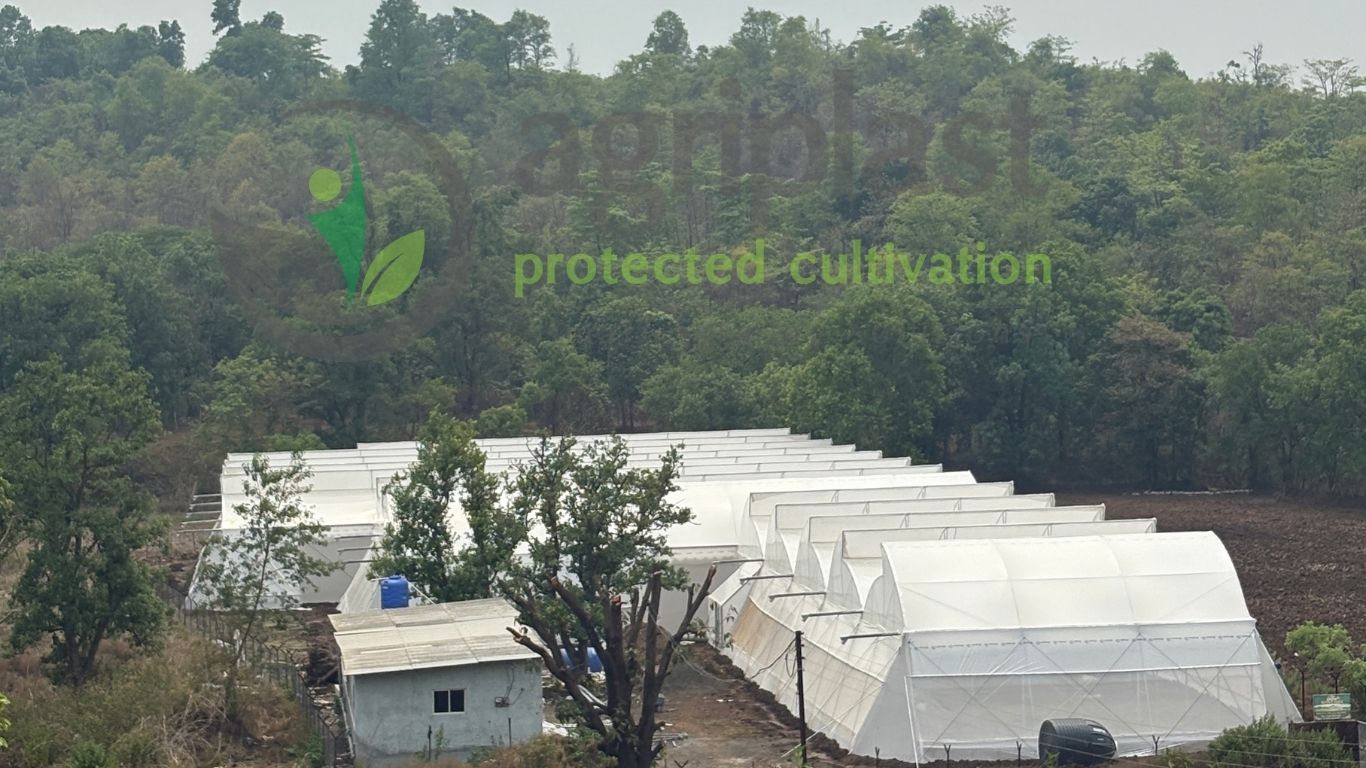
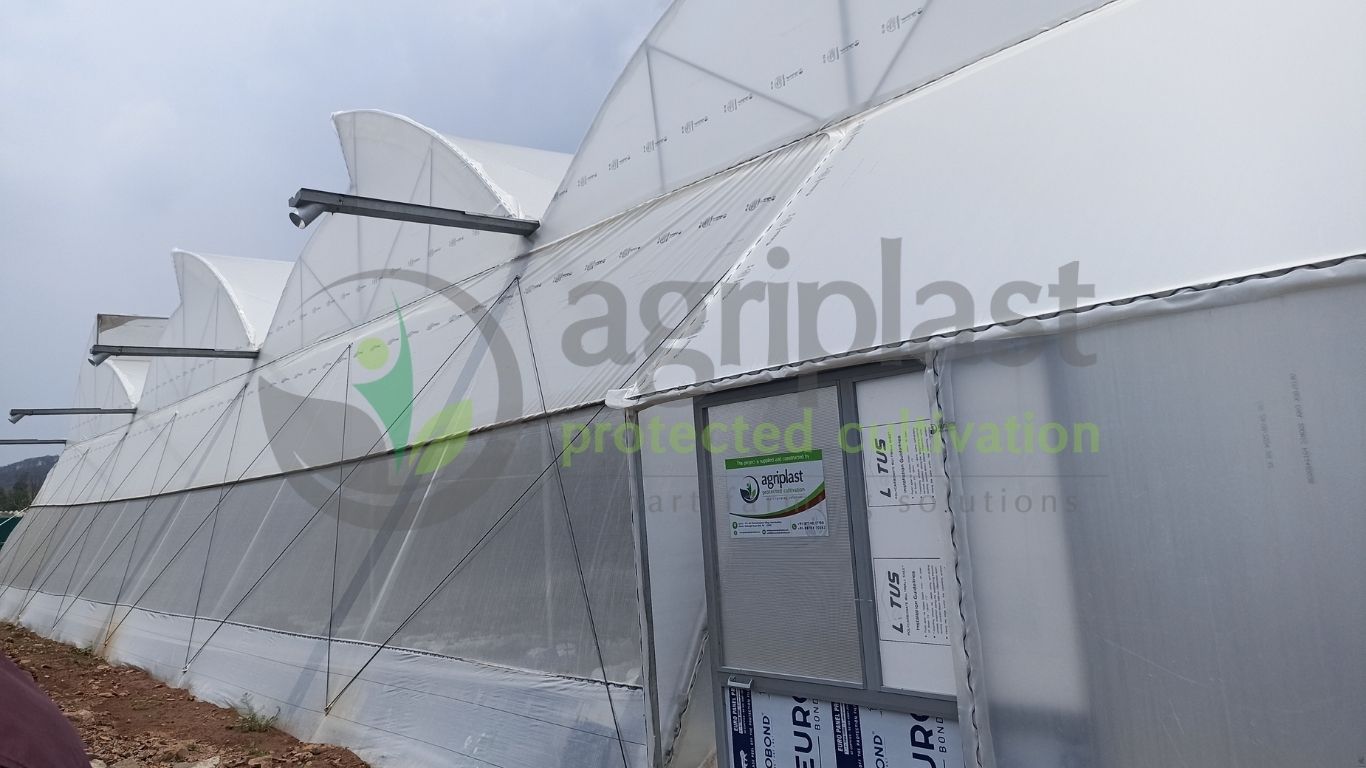
Agriplast Growers Cultivating Capsicum
What Are the Best Marketing Channels for Selling Polyhouse Capsicum?
Secure buyers before transplanting:
- Supermarket chains: long-term contracts, steady pricing, Grade-A only
- HORECA (hotels/restaurants): demands regular, high-quality supply
- FPOs and aggregators: buy at the farm gate, cutting transport costs
- APMC mandis: best for moving Grade-B volume during peak harvest, track live prices via portals like Kisaan Helpline Mandi Rates
Frequently Asked Questions
Q1: What is the recommended polyhouse size for beginners?
A 1,000 to 4,000 sq m (up to 1 acre) setup balances cost with manageable capital requirements for new commercial growers.
Q2: How long does a full crop cycle last?
9 to 10 months and harvesting starts around day 80 to 90 which continues for 6 to 7 months.
Q3: Can coloured capsicum be grown in hot, humid plains?
Yes, with a 4 to 5 meter gutter height, 80% side netting, and high-pressure fogging to manage summer heat.
Q4: Is soil cultivation better than hydroponic coco peat?
Soil needs lower upfront investment. Soilless grow-bag media gives more precise root nutrition control, removes soil-borne nematodes, and increases total yield potential.
Ready to Start Capsicum Farming in Polyhouses? Get Expert Consultation
Contact the Agriplast Protected Cultivation agronomy team for site assessment, construction planning, or turnkey polyhouse setup. Capsicum farming in polyhouse can yield 30-35 tons per 1 acre, but that number depends on site selection, structural setup, disciplined crop care, and buyer relationships secured before planting.
Get technical assistance and turnkey protected farming solutions directly from the Agriplast team.
Content Verified by Paras Mohindru (Horticulturist)
Agronomist Insights contributed by: Venugopala Reddy
Recent Posts
Your Farm. Your Future.
Every great harvest starts with the right conversation. Let our experts design a polyhouse built around your land, crop, and climate.
Talk to an ExpertFrequently Asked Questions
In this video, Abhishek Bhatt, Director of Agriplast Protected Cultivation, will provide a comprehensive breakdown of why Agriplast Polyhouse outperforms other polyhouses in terms of yield. He'll elucidate on key features like superior design, Israeli technology application, and optimal environmental control. The design facilitates enhanced ventilation, ensuring ideal growing conditions. Additionally, the use of Israeli technology, tailored for Indian agricultural needs, plays a crucial role in maximizing yields. Stay tuned to gain valuable insights into how Agriplast Polyhouse revolutionizes protected cultivation for superior agricultural outcomes.
A greenhouse is a transparent structure which is made using glass where plants are grown under certain climatic conditions. The agricultural industry has got many innovations, and the greenhouse technology makes use of modern and smart technology to give optimum facilities to the plants for their better and more efficient growth all around the year. Polyhouse is a kind of greenhouse where polyethene plastic material is used to create the polyhouse instead of the use of glass.
A greenhouse is designed to grow plants even in adverse climatic conditions. The translucent glass that covers the greenhouse gives the plants enough light to let them carry the photosynthesis process easily by absorbing light energy. Since the greenhouse is in an airtight condition, a sufficient amount of sunlight makes the greenhouse warmer from within than the outer atmosphere.
Greenhouse not only warms the greenhouse from within only in summers but in winters; it allows for an artificial heating solution which is effective but is a bit expensive. Some other inexpensive ways of warming up your greenhouse are:
- If you cover the inside of a greenhouse structure with a bubble layer wrap, you will observe a reduction in heat loss.
- Good power supply availability will allow you to add electric fan heaters to circulate hot air within the greenhouse for the plant's growth.
- You can also get electric greenhouse heaters installed that come with an inbuilt thermostat and works automatically when the temperature of the outer surroundings goes down.
Greenhouse benefits you in several different ways, which are listed below:
- Helps in producing fresh crops at any time of the year.
- The facility of producing the crops all around the year, even in adverse climatic conditions.
- The greenhouse allows the farmers to create an exclusive environment for the better plant growth.
- Protects crops from adverse climatic conditions.
- The light energy within a greenhouse is distributed evenly to all the plants.
- Greenhouse installation makes it easy for the farmers to grow crops with less use of pesticides.
- Greenhouse setup helps in saving the total usage of resources.